
The quality of your tattoo at year five depends almost as much on how you healed it as on how it was tattooed. Most aftercare problems are avoidable: too much product, too little patience, too much sun, too many gym sessions. This guide walks through what to do (and not do) on each day, what's normal, and when something genuinely warrants a doctor.
Always defer to your artist's specific instructions. They saw your skin, they used specific products, and they know whether they wrapped you in plastic film or second skin. The guidance below is general.
The three healing timelines
It helps to keep these in your head as you go:
Surface healing (2–4 weeks): skin looks normal, no peeling, no scabs.
Full settle (4–6 weeks): ink finishes locking in, color stabilises.
Deep dermal healing (up to 3 months): invisible from the outside, but your dermis is still finishing the job. Avoid heavy abrasion.
Don't judge the final look until you're solidly into month two.
Day 0 ( The day you get tattoed)
Your artist wraps the fresh tattoo before you leave. Two main wraps:
Plastic film or absorbent pad: keep on for 2–6 hours. Do not re-wrap once removed.
Second skin (Saniderm, Dermalize, etc.): stays on for 2–5 days. You may see plasma and ink pool inside the film — that is normal. If the seal breaks early or the film leaks, remove it carefully in a warm shower and switch to traditional aftercare.
Your tattoo is technically an open wound. Treat it like one.
Eat. Hydrate. Sleep early.
No alcohol — it thins blood and prolongs swelling.
Don't touch unless your hands are clean
Day 1: the first wash
Once the initial wrap is off, give the tattoo its first proper clean.
Wash hands first, fragrance-free soap.
Run lukewarm water over the tattoo. Use clean fingertips and unscented liquid soap to gently clean off plasma, blood, and excess ink.
Rinse thoroughly. Pat dry with a clean paper towel — not a bath towel (towels harbor bacteria and snag scabs).
Let the tattoo air-dry for 10–15 minutes before applying anything.
Apply a thin layer of the aftercare balm your artist recommended. Thin is the operative word — a glossy sheen, not a coat. Over-application suffocates skin and traps bacteria.
Repeat the wash 2–3 times that day if you can. The tattoo may feel hot, look slightly puffy, and ooze a small amount of plasma. All normal.
Days 2 - 3: de settling phae
Swelling and redness peak around now and start to recede. The tattoo may look slightly dull as the top layer of skin starts forming a thin protective film.
Continue washing 2–3 times a day.
Moisturise 2–3 times a day, only when the skin feels dry. If it still looks shiny from the last application, wait.
Wear loose, breathable clothing over the area. Friction is the enemy.
Sleep on the opposite side if possible. If unavoidable, put a clean cotton sheet over the area.
Avoid: gym, sauna, hot showers (lukewarm only), sun, alcohol, swimming.
Days 4 - 7: the itch pase
This is where most first-timers slip up. The top layer of skin starts to flake and peel — exactly like a sunburn. It will itch.
Do not scratch. Scratching pulls flakes off prematurely and takes ink with them. Patchy healing happens here.
Do not peel flakes off. They look ugly. They will fall off naturally in days.
If the itch is unbearable, slap the area gently or apply a tiny dab of moisturiser. The itch fades after a few seconds.
Keep the wash + light moisturise routine. The tattoo may look bizarre during peeling — colors look faded, lines look fuzzy. This is temporary. Do not panic.
Week 2: surface healing wraps up
The peeling phase ends. The tattoo enters a thin, slightly shiny "new skin" stage. It might look duller than you remember from the studio. That dullness is the new top layer; it will become more transparent as it matures, and the colors will look closer to fresh by the end of week 4.
Drop washing to once or twice a day.
Continue moisturising as needed — typically once or twice a day now.
Loose clothing, no friction, still no swimming, still no sun.
Light cardio is fine; avoid anything that grinds or stretches the area.
Weeks 3- 4: entry to normal life
Most surface healing is done. You can usually:
Resume normal showering (still no baths, hot tubs, or pools).
Resume gym sessions, including the area being tattooed, with care.
Wear normal clothing.
Still avoid:
Direct sun (or apply SPF 50 if exposure is unavoidable; for the first month, prefer to cover with clothing).
Submersion in pools, hot tubs, sea — these are the last things to reintroduce, around week 3–4 at the earliest.
Aggressive scrubbing or exfoliating the tattoo.
Continue moisturising daily until the area feels and looks like normal skin.
Weeks 5 - 8: full settle
The ink is now fully sitting where it belongs. The tattoo looks the way it'll look. If anything dropped out during healing — a thin patch, a softened line, lost color in fine areas — this is when it's clear. Don't worry: this is what touch-ups are for.
Most artists offer a free touch-up between weeks 6 and the 6-month mark for areas that didn't take. Fingers, hands, feet, and elbows are the most common touch-up zones because of how skin sheds in those areas. Wait until at least week 6–8 before scheduling.
Long term, the forever routine
The single biggest factor in how a tattoo ages is sun.
SPF 50, every exposure, forever. UV breaks down ink pigment faster than any other factor. A tattoo that lives in the sun without protection can fade noticeably in 5 years; a protected one looks crisp at 20.
Moisturise. Hydrated skin keeps ink looking saturated.
Avoid drastic weight changes where possible. Skin stretching and shrinking distorts placement and lines.
No bleaching agents or aggressive retinoids over the tattoo unless your dermatologist specifically clears it.
What's normal vs. what isnt't
Normal (don't panic):
Mild redness, warmth, and swelling for 24–72 hours
Plasma weeping (clear or slightly cloudy fluid) for the first 2–3 days
Itching, peeling, and flaking from days 4–10
Temporary dullness during weeks 2–3
Slight raised feeling on the lines for a few weeks
Small ink dropouts on fingers, hands, and feet — touch-up territory
See a doctor (not a tattoo artist):
Spreading redness expanding past the tattoo outline after day 3
Increasing pain after day 3 (it should be decreasing)
Yellow or green pus, foul smell
Red streaks moving away from the tattoo (sepsis warning sign)
Fever or chills
Hard, hot lumps under the tattoo
Unusual rash, hives, or blistering — possible ink allergy
Bring photos and the consent form (which lists the inks used) to the appointment.
Quick aftercare FAQ
Can I cover my tattoo with a bandage if I'm worried about it? Only if your artist instructs it. Bandages over a fresh tattoo trap moisture and can encourage bacterial growth after the first wrap is off.
My tattoo scabbed. Is that bad? Light, thin scabs are normal. Thick, raised, dark scabs suggest the artist went deeper than ideal or you over-moisturised. Don't pick. Let them fall off.
The peeled skin has color in it. Am I losing my tattoo? You're losing dead surface skin that absorbed ink as the wound healed. The tattoo is in the layer underneath. Calm down.
Can I run / swim / cycle / lift?
Running and light cardio: 48–72 hours.
Lifting and high-sweat gym: 5–7 days.
Swimming, hot tubs, baths: 3–4 weeks minimum, until skin is fully closed.
My tattoo looks faded after peeling. Did the artist mess up? Probably not. The temporary dull look during weeks 2–3 is the new skin layer. By week 5–6 the saturation usually returns. If a section is genuinely thin at the 6-week mark, book a touch-up.
A tattoo is a relationship between your skin, your behaviour, and your artist's work. Aftercare is the part you control — and it's the cheapest insurance you'll ever buy on a piece of art that's going to be with you for life.
Nice links:
Related articles
All articles →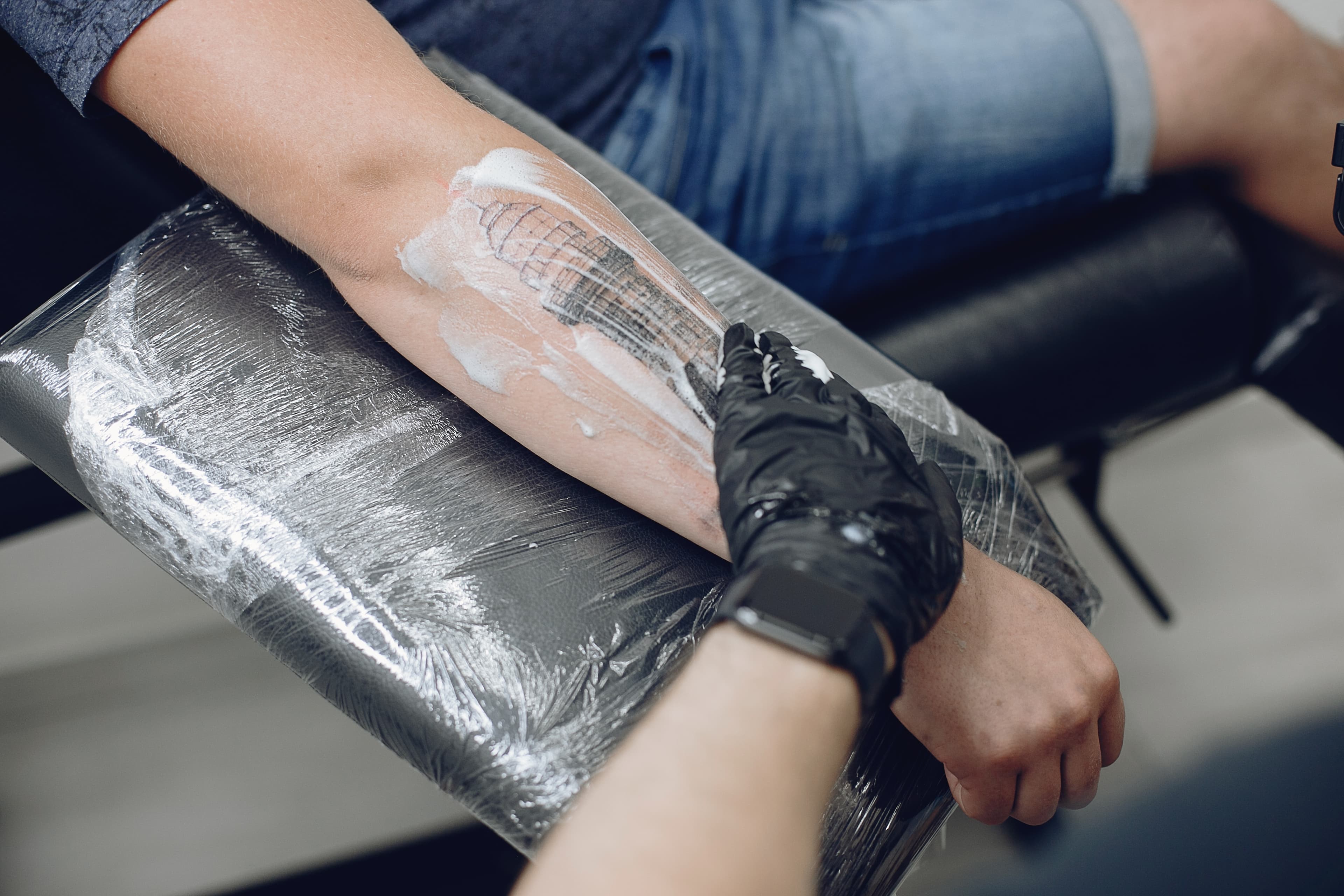
Tattoo aftercare day by day
The quality of your tattoo at year five depends almost as much on how you healed it as on how it was tattooed. Most afte
May 3, 2026
Je eerste tattoo: De complete checklist 2026
Your first tattoo should feel like a deliberate choice, not an impulse. The design will be on your skin for the rest of
May 3, 2026